March 11, 2005 Closing the Gap and Our Website Community
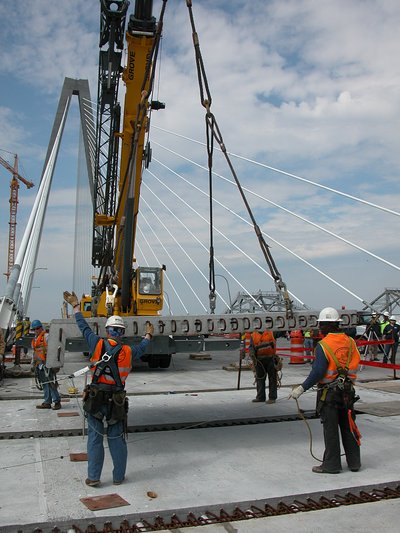
Many engineers and many more armchair engineers have joined our conversation. When I encountered puzzles, many were quick to respond with answers. For example Joe Krolak, an hydraulic engineer with the Federal Highway Administration, Bridge Divistion, helped me understand how one stabilizes barges that support cranes while erecting girders while Boyd Gregg, a civil engineer with Black & Veatch in Alpharetta, Ga helped me understand the concept of tensioning - specifically when I encountered PBC tensioning the lateral tendons that stabilized the central segment of the east and west pylons. So I copied and pasted Boyd's explanation into the details web page. When I really got into engineering trouble, David Wertz with SCDOT and Marvin Tallent with PBC helped me understand what was happening.
More recently, Peo Halvarsson provided opportunities to explore different aspects of building the main deck and Oliver Forget with Freyssinet helped me understand erecting cable stay pipes and pulling strands of cable. I had a chance to see many things that simply increased my curiosity. During these times, I met Wilbur Poole, an iron worker who also manages the hydraulic systems used to position the deck. All these folks were my teachers and I transferred what I learned to these pages.
But many many people simply sent email to encourage me to continue. These are the people that energized me to continue my weekly visits to the SC Aquarium to take my "core data". Then Tina Cotter got into the picture. Her husband, Philip, an iron worker, named one of the deck erection cranes "Last Dinosaur Standing", the kind of humor that really turns me on. When Tina told me the crane story, I could not resist adding some humor to the placement of the last concrete floor panel - was Philip signaling the crane operator, or was Philip secretly waving to Tina? Look at the photo above and you be the judge.
What I am trying to say is that this web site is a community project - not just Frank Starmer taking photos for his grandkids. The stories and photos reflect significant influences from two of my kids - Michael told me a long time ago that my photos were chaos. "Never take a photo unless you are prepared to tell a story". Not only good advice, but great advice. Josh then introduced me to the humor side of photo essays with his dialog associated with photos of my work in south India (2001).
Gene Stead, chairman of Medicine at Duke, was my first boss and taught me the joy of learning. Gene asked lots of questions - not because he was testing people, but because he was curious. Gene helped me to understand that being curious was OK - not something that should be suppressed as one becomes a teenager. My dad was also very curious and shared with me that he never met someone from whom he could not learn something. The Internet and Google level the playing field for all of us curiosity chasers. And these web pages are really an experiment in what I call Internet-centric learning. The days of teachers and students are nearing an end and a new Internet-centric learning paradigm is evolving. As with Gene - we are all learners in this world - traditional teachers are more like senior learners while traditional students are simply junior learners.
So these web pages are all about learning, my curiosity and your encouragement. What started as a simple set of photos has evolved to what we have now - a sort-of read write web site where many of you contribute to my understanding aspects of building the new Cooper River Bridge.
I am grateful for your help, for your curiosity and for your encouragement. posted at: 10:11